Getting a publishing deal
Magazine
IntroductionOur last survey asked writers for views about the obstacles they have faced in trying to get their work published. The results cannot be easily expressed in a simple statistical format. However, your comments, opinions and suggestions have yielded fascinating material, even though they have needed more interpretation. So, a few charts are attached as part of the survey results, but we have used the respondents’ own words to highlight the very interesting findings from the survey.
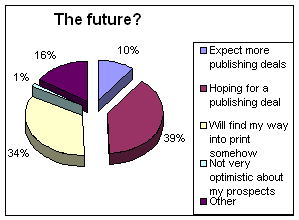
How to get publishedWe were looking at the obstacles faced by writers. Some clear patterns emerged among the replies to our latest survey. If you want to get a publishing deal, become a journalist, be prepared to contact at least 10 agents or publishers and don’t ignore self-publishing. And when you do get a deal, don’t assume the publisher will take your future titles. Learning to write what people want to read was, not surprisingly, a long road down which many travelled before reaching their publication deal. Getting a dealFinding a publishing deal is not easy. For all writers, the average number of submissions it took was 9.5 agents and almost seven publishers. Interestingly, most writers, published as well as unpublished, contacted agents as well as pitching their work directly at publishers. However, the detailed picture is complex. A few of the successful writers had evidently found the publisher the first time they submitted their work and we will look at these lucky ones later. And there is more to say about writers who keep the postal service in business with 50 or more submissions to agents or publishers. A more accurate picture would be that you need to contact a combination of 10 agents and/or publishers. If you have sent out many more than that, it is time to take a long hard look at what you are sending. Persistence, alone, does not appear to pay off, although most of those who had been published found the first deal required multiple approaches. The exceptions to this rule can be found among writers of academic books and several respondents who identified themselves as journalists. The former had books commissioned. The journalists were candid in confessing that it was contacts that won them a publishing deal. One said ‘building a network of contacts and being reliable and delivering on time’ was their recipe for success. However, another journalist who had published hundreds of articles said their deal came through a ‘combination of perseverance and networking.’ One surprising result was that half those in print had more than one publisher. This was sometimes explained by the range of topics covered. Several authors had fiction, fantasy and romance books published. So each writing genre needs to be marketed afresh. Get publishedThe correlation between having multiple articles published and obtaining a publishing deal was very good with over 90% conforming to this stereotype. Fiction writers had their short stories published. Successful non-fiction writers had scores of articles to their credit. The moral seems to be to start small. All successful writers have published articles or stories. Given that half of the published writers were journalists or professional writers already, it is impossible to say if it was networking or learning the writing craft that had led to their success with book publishing. The persistence of those who had been writing for over 5 years was impressive. They remain optimistic that they will succeed. They should take heart. Every published writer in our sample has manuscripts which have remained unpublished. Published writers also self-publish. Only two said that this was an option they would not consider. Others felt their work deserved publication, even though it had been rejected by agents and publishers. AgentsNobody in this survey had many good words to say about agents. Indeed there were some harsh opinions about their role in the publishing business. 'I haven't found a novel way to get to an agent - seems like finding a marriage partner, more luck than skill.' ‘Extracting even the courtesy of a reply from agents who clearly don't need to bother with such frivolities. I overcame this by realising that if they were going to treat me in such a cavalier way, how much could I rely on them as a client?’ ‘Nothing has worked for me yet. My book has been languishing at an agent’s for almost a year. He's not said whether he'll rep me, but hasn't said no. I've tried contacting him several times, but he doesn't respond. Agents are a species of sub-human that are a necessary evil.’ But Simon Trewin, former Secretary of the Association Of Authors' Agents, say he does not recognise this view of agents. He manages to deal with around 3,500 unsolicited manuscripts every year. He points out that he can eliminate half of these because they are material that he does not handle. Remember to do your research and don’t instantly blame the agent if your script is returned unread. From among the thousands of manuscripts he reads, Simon finds about four he agrees to represent. How does he manage to read nearly two thousand manuscripts each year? ‘Short weekends and few holidays’. Talking to other agents, this workload and number of mss taken on appear normal. If you want to be the one in 500 that an agent will take on, aim high is Simon’s advice. The mid-list is a crowed environment so the author’s personality needs to come through. ‘Start out thinking "the world doesn’t need another novel". Then you will realise you have to take yourself seriously as a writer and produce something very special.’ The writers among the sample in this survey had the same success rate when going direct to publishers compared with going through an agent. This might be a fault in the survey design. It was impossible to separate fiction from non-fiction. The best guess is that a direct approach to a publisher makes sense for non-fiction. However, as Simon confirmed, it is vary rare for fiction writers to succeed without the support of a literary agent. ConclusionSo if you want to overcome the obstacles to publication and become a published writer, the survey suggest that you:
Some other contributions
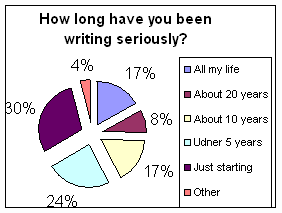
The sampleThe median age of the 107 valid responses is 45.0 years (slightly up on the norm) As usual, 55% of the replies were from women. On this occasion a third gender option was offered, and 5 respondents opted for this category. Unless the pattern of replies has altered compared with the previous surveys, the 5 ‘others’ are probably biological males who took advantage of the space to provide more information about their writing. The credibility of the responses is difficult to assess. Three responses from the sample were eliminated as the replies were simply not credible. However, the narrative that ran through the rest of the responses was credible and it proved possible to sort the replies revealing consistent results. May 2005 ©Chas Jones 2005 |
|||||||||||||